
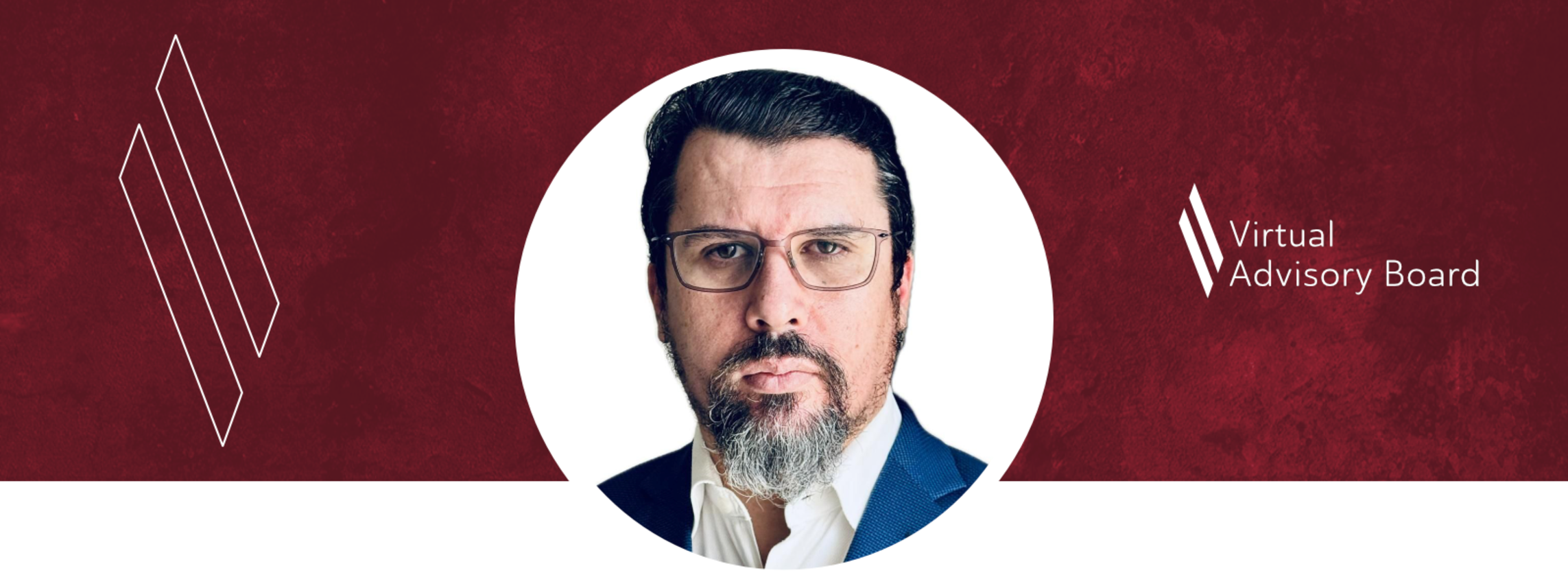
Mohammed Adlani – Get to know our VAB member
We would like to introduce you to VAB member, Mohammed Adlani, who joins our community from Saudi Arabia. He is an architect of AI-Native enterprises and national-scale digital economies who as a 22-year track record bridging enterprise strategy and emerging technology across Tier-1 telcos, global consulting and diversified holding groups. The latter projects span across Europe, Africa and the GCC. Mohammed has delivered national-scale digital transformation at STC, AI and cloud ventures at AjlanTech along with public sector outcomes at Accenture — consistently converting technology investment into measurable business value. As a CIO/CTO he is committed the helping architect the intelligent, sovereign digital ecosystems that will define Saudi Arabia's digital economy over the next decade.
What inspired you to become part of the Virtual Advisory Board (VAB) community? Professional transition, a search for board opportunities, the wish to build a portfolio career?
My inspiration was a natural evolution — after 22 years of delivering national-scale transformation across telcos, consulting and holding groups, I reached a point where my highest value is no longer within a single organisation but across ecosystems. VAB seemed to me to be the right vehicle for translating deep ICT expertise and Vision 2030 alignment into board-level influence — shaping digital economy strategy, technology sovereignty and AI governance at a level that transcends any single executive role. For me, personally, it is less about portfolio building and more about catalysing systemic change in Saudi Arabia's digital future.
Describe your biggest challenge with your current career or professional transition process? Where would you invite help from the VAB community and, conversely, how do you feel you can best support your VAB peers?
My biggest challenge is the perception gap — transitioning from a highly operational VP-level mandate at STC into a C-suite role where boards and search committees recognise me as a strategic architect rather than a senior technology manager. Quantified delivery at national scale does not always translate automatically into board-level visibility, particularly in a market where CIO/CTO appointments remain heavily relationship-driven.
In joining the VAB community, I am hoping to access (and further build my own) board-level networks and executive search relationships within the Saudi and GCC ICT ecosystem and to get candid guidance on how C-suite peers have navigated the final step from VP to Chief Officer — particularly within regulated, Vision 2030-aligned organisations. Conversely, for my VAB peers, I can offer 22 years of hands-on expertise across the full digital transformation spectrum — telco architecture, AI adoption, cloud strategy and regulatory navigation across CITC, NCA and SDAIA frameworks. For peers entering or scaling within the Saudi market, I offer grounded, practitioner-level intelligence on Vision 2030 alignment, Saudisation leadership, and how to position technology as a sovereign economic asset rather than an operational cost. My cross-sector exposure across Europe, Africa and the GCC also adds genuine comparative perspective that benefits fellow members and their businesses operating across multiple markets.
Where would you like your next career or professional opportunity to take you? In what type of organisation or role do you feel you could make the most impact?
My next opportunity is a CIO or CTO mandate within a Tier-1 telecommunications operator, a national champion organisation or a sovereign-backed entity directly executing Saudi Arabia's Vision 2030 digital agenda — where the scale of impact matches the depth of experience I bring.
The organisations where I make the most impact share three characteristics: they are at an inflection point — either mid-transformation requiring strategic acceleration, or pre-transformation requiring an architect to design the journey from the ground up; they operate at national or regional scale where technology decisions carry genuine economic sovereignty implications; and they have strong appetite for technology as a growth engine rather than a cost centre. Specifically, I see the highest-impact opportunity in one of three contexts: a Tier-1 telco or digital infrastructure operator scaling AI-native platforms, monetising 5G and edge capabilities and navigating the convergence of connectivity and digital services; a Giga-project or sovereign wealth-backed entity — NEOM, PIF portfolio companies, or similar — where greenfield digital ecosystem design demands both visionary architecture and disciplined execution; or a diversified holding group or national conglomerate undertaking serious digital and AI transformation of its core business units, requiring a CTO who can operate across subsidiaries and govern technology as a value-creation portfolio.
What resources have helped you most in managing the ups and downs of the psychological journey related to professional transition? Is there a book, a podcast, a coaching service or some other tool that has guided you on your way forward?
The most impactful resources in navigating my professional transition have operated at two levels — intellectual reframing and behavioural recalibration.
Harvard Leadership Programmes fundamentally shifted how I process transition. The frameworks around adaptive leadership taught me to distinguish between technical problems — which experience solves — and adaptive challenges, which require identity-level change. That distinction alone reframed my transition from a job search into a genuine leadership evolution. The executive education environment also provided a type of support often underestimated: the exposure to peers at equivalent career inflection points, which normalised the ambiguity and dissolved the isolation that senior transitions often carry.
The Trusted Advisor by Maister, Green, and Galford became a quiet but powerful compass. Its core insight — that influence at the highest levels is earned through the sustained demonstration of selfless client focus rather than technical credibility alone — directly challenged me to reposition how I show up in executive conversations. The Trust Equation reframed my transition narrative: I stopped leading with what I know and started leading with what I can solve for others. For someone moving toward CIO/CTO appointments, this shift from expert to trusted strategic partner is not cosmetic — it is the entire game.
Where do you find you do your best strategic thinking? Be creative and surprise us.
My best strategic thinking happens at the intersection of human stillness and systemic complexity — and I have learned, after 22 years, that the two are inseparable.
Not in boardrooms. Not in strategy offsites. My clearest thinking emerges in the margins of disruption — standing inside a newly digitised government service centre watching a citizen interact with a platform my team built, or sitting with a young Saudi engineer at STC who just automated their first network function and does not yet realise they have changed their own economic trajectory forever. Those moments collapse the abstraction. Technology strategy becomes human strategy. This is the insight that most executive frameworks miss: digital transformation is not a technology programme — it is a civilisational behaviour change at scale.
I process this through consistent immersion in human knowledge domains that most technologists ignore — leadership psychology, behavioural economics, philosophy of change, and the sociology of institutions. The Harvard leadership programmes reinforced what practice had already taught me: that the limiting constraint on digital transformation is never the technology. It is always the human system surrounding it — its fears, incentives, narratives and capacity for adaptive change.
So my strategic thinking lives in that uncomfortable, generative space where disruption meets dignity — where I ask not only what can this technology do, but what does it ask of the people it touches, and are we leading them through that ask with the care and courage it demands.
That, ultimately, is what inspirational leadership means to me — not the vision statement on the wall, but the human transformation quietly happening beneath the digital one.
