
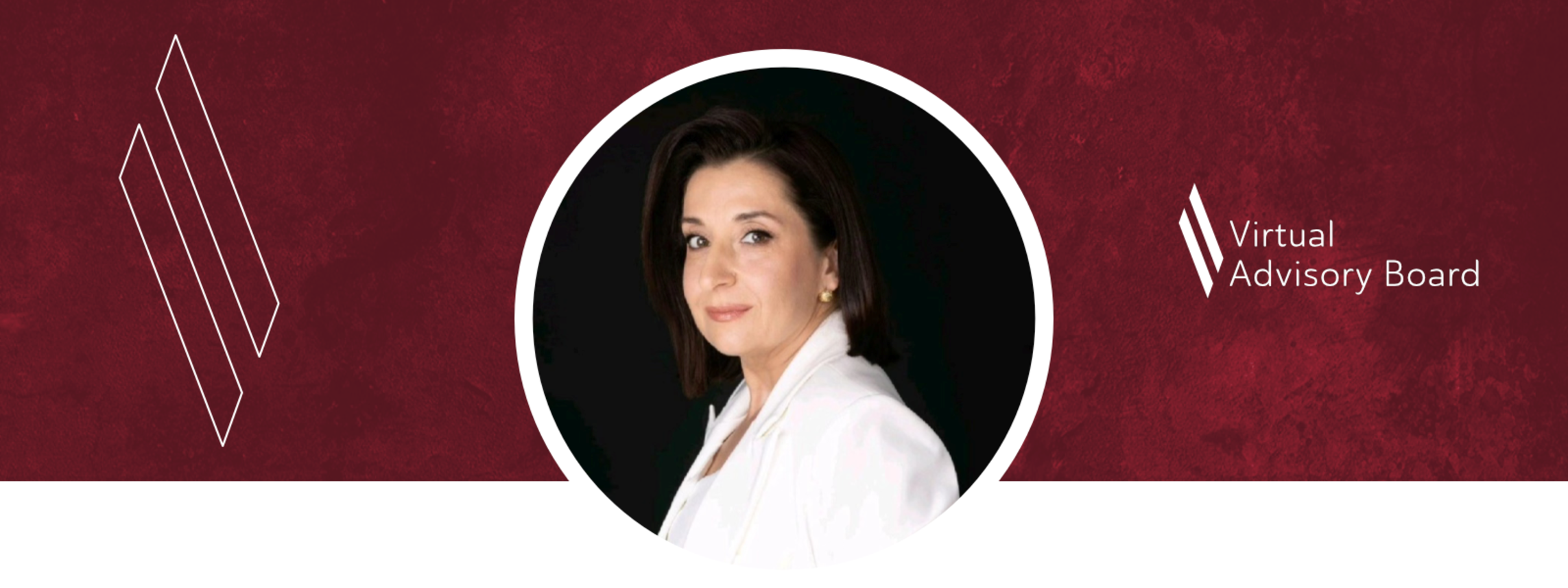
Dora Matsia – Get to know our VAB member
We would like to introduce you to VAB member, Dora Matsia, who joins our community from Athens, Greece. She is a civil engineer, project manager and founder of MODERAMEN. Dora has almost 30 years of experience leading complex projects across construction, industrial, commercial and investment environments. She works at the intersection of strategy, governance and execution, helping organisations create structure, align stakeholders and turn complexity into value.
What inspired you to become part of the Virtual Advisory Board (VAB) community? Professional transition, a search for board opportunities, the wish to build a portfolio career?
I joined VAB because I realised that my professional journey was evolving beyond project delivery itself. I became more interested in broader questions: governance, strategic decision-making, leadership and long-term impact. At the same time, I strongly believe that growth happens in communities. Being surrounded by experienced professionals with diverse backgrounds creates the kind of thinking and perspective that no single career path can offer alone.
Describe your biggest challenge with your current career or professional transition process? Where would you invite help from the VAB community and, conversely, how do you feel you can best support your VAB peers?
One of the biggest challenges in a professional transition is not developing new skills, it is repositioning your own narrative. Sometimes others see your next step before you do.
Coming from a strong operational and project leadership background, my current challenge is translating years of experience in various industries into a broader strategic, board-oriented context. I would value support from the VAB community in understanding board pathways, governance dynamics and how experienced leaders have navigated similar transitions.
In return, I believe I can contribute with my experience in project leadership, stakeholder alignment, governance frameworks and connecting strategy with execution. I also genuinely enjoy mentoring and helping people achieve clarity when situations become complex.
Where would you like your next career or professional opportunity to take you? In what type of organisation or role do you feel you could make the most impact?
I would like my next opportunity to bring me closer to strategic leadership and advisory roles, where I can contribute not only to delivering projects but also to shaping decisions. I believe I create the greatest impact in organisations undergoing growth, transformation or comprehensive change. This usually involves environments where people, operations, investments and long-term objectives need alignment. I am particularly interested in roles where governance, leadership and execution intersect.
What resources have helped you most in managing the ups and downs of the psychological journey related to professional transition? Is there a book, a podcast, a coaching service or some other tool that has guided you on your way forward?
For me, the most valuable resource has actually been people. Books, courses and podcasts provide knowledge, but meaningful conversations often provide perspective. Mentors, communities and honest discussions with people who have walked similar paths have helped me navigate uncertainty. Psychotherapy has also been an important part of this journey. It helped me develop greater self-awareness, challenge limiting patterns and create space to understand not only where I wanted to go professionally, but also why. I have learned that professional transitions often start as external changes but eventually become internal ones.
Where do you find you do your best strategic thinking? Be creative and surprise us.
Usually somewhere between movement, silence and a blank page.
Some of my best strategic thinking happens while driving alone, looking at the sea, or during long walks without music. But one practice that has become surprisingly powerful for me is journaling. I have realised that writing (by hand, the old school way) slows down the noise of the mind. Thoughts that feel tangled, urgent or overwhelming suddenly take their real shape on paper. Priorities become clearer, emotions separate from facts, and what seemed complex often becomes much simpler.
Interestingly, I also find clarity inside project sites. There is something about standing in the middle of building sites - with noise, people and moving parts everywhere - that suddenly makes priorities obvious. Sometimes strategy is not created in meeting rooms; sometimes it emerges the moment the noise becomes quiet enough for us to hear ourselves think.
